
Choosing Nursery Pot Sizes for Plant Nurseries
When you’re starting or running a plant nursery, choosing the right nursery pot sizes can make a big difference in both your workflow and your bottom line. Over the years, we’ve experimented with all sorts of containers and learned what works best for us—and what doesn’t. In this guide, we’ll break down the most common nursery pot sizes, share our real-world tips, and help you avoid some of the pitfalls we’ve encountered along the way.
What Are the Standard Nursery Pot Sizes?
Nursery Pot Size Chart (With Volumes)
Here’s a quick reference for the most common nursery pot sizes used in commercial plant nurseries:
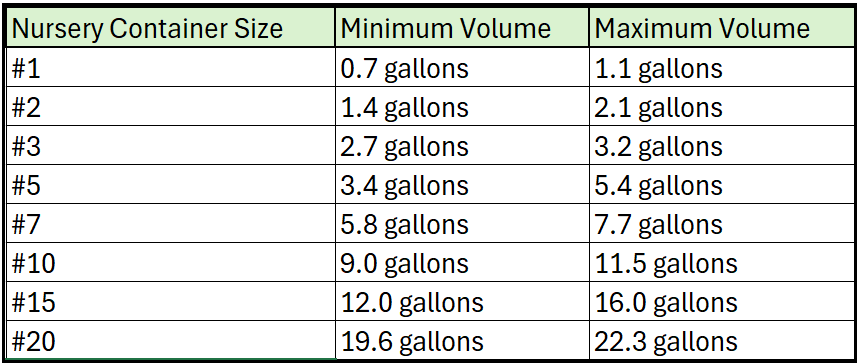
Note: Actual volumes may vary by manufacturer, but this chart covers the typical range you’ll find in the trade.
How to Choose the Right Nursery Pot Size for Your Plants

Plastic vs. Fabric (Non-Woven) Nursery Pots – Grow Bags: Pros and Cons
There are two main types of nursery pots we use: traditional plastic pots and non-woven fabric (or “soft”) pots. Here’s what we’ve learned about each:
- For #1 size, plastic pots are extremely inexpensive, but quality varies widely. The cheapest ones are flimsy and often stick together, making them frustrating to use. For larger sizes, prices even out and quality improves.
- These pots come with sturdy handles, making them easy to move around. They’re also simple to store and don’t get stuck together like plastic pots. Not all non-woven pots are created equal—some brands are much better than others, so it pays to do your research. We’ve found the brand Gardzen, to be superior in quality, easy to order on Amazon, and holds up well season after season.
- For most sizes, plastic and non-woven pots are fairly close in price, except for the smaller #1 size pots, where plastic is much cheaper. However, the quality of the very cheapest plastic pots is usually poor unless you pay a little extra.
How Pot Rigidity Affects Watering: Plastic vs. Non-Woven Grow Bags
Plastic nursery pots have one positive feature over non-woven grow bags: rigidity. Because plastic pots are sturdy, the tops always stay fully open, making overhead watering efficient since the pot is always fully accessible at the top. With non-woven grow bags, quality matters—a lot. Lower-quality fabric pots, or those that aren’t filled with soil nearly to the top, tend to collapse inward. When this happens, the sides can fold in toward the plant, partially covering the upper soil surface and making watering more difficult. We’ve found that investing in better-quality non-woven pots helps avoid this issue, and it’s still important to fill any grow bag close to the top with soil to help it keep its shape.
Tips for Buying Nursery Pots (and Saving Money)
- Buy Off-Season: Pots are often cheaper in the off-season or on sale days. We stock up when prices are low.
- Compare Quality: Especially with #1 pots, don’t just go for the lowest price. A little extra for quality pays off in the long run.
- Storage: Non-woven pots are easy to stack and store, and you don’t have to wrestle them apart when you need them.
Why We Avoid #1 Pots in Our Nursery
While #1 pots are cheap and easy to find, we rarely use them. The plants are smaller, but the work is the same as growing in a #2 or #3 pot but the sale price of a larger plant is much more, for the same amount of work. Yes, you have to wait longer for a saleable plant but it will sell fast for twice as much. Have to add, #1 pots are constantly falling over, especially outside in the wind and they dry out very quickly. For us, #1 size pots and plants are kept to a minimum, it’s just not the right size for us but we do still use some.
Our Nursery Potting Approach (And Why It Works for Us)
Every nursery has its own way of doing things. We’re not saying our method is the only right way, but after years of trial and error, this is what works for us:
- We pot directly into the container size we plan to sell in—usually #3, #5 and even some #7 size nursery pot sizes.
- We use both plastic and non-woven fabric pots, depending on the plant and the season. We are at 80% Non-woven.
- We buy pots in bulk during off-season sales and generally our preferred brand, easily purchased on Amazon is Gardzen, these are substantially better quality, have strong handles, don’t fold in, and hold up for years.
- We avoid the smallest pots (#1) because they tip over easily and don’t save us any work in the long run.
If you’re just starting out, experiment a little and see what fits your setup, the plants you want to sell, and your workflow. There’s no one-size-fits-all solution, but hopefully, this guide helps you avoid some common mistakes and choose the best nursery pot sizes for your plant nursery.
Some quick links to get you to some important articles quickly
Starting a backyard plant nursery – Getting Started
Starting a plant nursery – For those starting a larger nursery
How to start a plant nursery Start a plant nursery with a low investment
Retirement Investment – Plants can be a good retirement investment
Start a business before you retire – Now is the time!
Backyard Nursery Resources – Our ever growing resources guide for your backyard Plant Nursery
Planting in the Fall or Spring, which is best?
Pruning Spruce Trees for the best health and profit
Propagating Japanese Andromedas
Propagating Variegated Wintercreeper Euonymus
Note: Some links in our website are affiliate links where we make a very small fee when you purchase. This does not cost you more but does help us keep this website running and growing.